


The IGCSE exam is an internationally standardized examination widely used to assess a student’s academic readiness before entering advanced programs such as A-Levels, the IB Diploma, or university foundation tracks.
Effective preparation for this exam is not just about how much or how early you study. Rather, it is about understanding how the IGCSE exam is designed, how the papers are constructed, and how scores are evaluated.
In this article, Renaissance will help you understand the nature of the IGCSE exam, the various exam boards, how to choose the right subjects, and the decisive factors for your results.
Cambridge igcse exam
What does the IGCSE exam assess?
The IGCSE exam goes beyond simple rote memorization. The core objectives of the exam are to evaluate:
- Depth of knowledge within the syllabus.
- The ability to apply knowledge to new situations.
- The capacity to present thinking logically, structurally, and academically.
Consequently, IGCSE exam papers typically:
- Avoid repeating exercises exactly as they appear in textbooks.
- Utilize specific command words such as “explain,” “analyze,” and “evaluate.”
- Require students to explain their thought process, compare, and evaluate rather than just providing a final answer.
This makes exam-taking skills just as vital as foundational knowledge.
Exam Boards and Differences in Assessment
IGCSE exams are provided by three main boards, each with a different approach to designing papers and evaluating students.
Cambridge Assessment International Education (CAIE)
Cambridge Assessment International Education (CAIE)
CAIE is the most popular exam board globally and is considered exam-oriented:
- Most of the grade is derived from final exams.
- There is little to no coursework in many subjects.
- Papers require students to demonstrate academic ability within a limited timeframe.
This approach suits students who perform well under exam conditions and prefer a clear assessment structure focused on official sittings.
Pearson Edexcel

Pearson Edexcel places more emphasis on the learning process and continuous assessment:
- The curriculum includes many intermittent tests.
- It offers an extensive system of revision materials and resources.
- It features a diverse list of subjects.
This approach supports students who benefit from regular feedback and guided practice.
Oxford AQA
Oxford AQA is the newest of the three providers and stands out for:
- A combination of classroom assessment, coursework, and exams.
- A modern approach to exam design.
- An expanding catalog of subjects and materials.
This board is suitable for students who thrive in continuous assessment environments and prefer highly applicable learning.

Oxford AQA
Choosing Fewer Subjects—But the Right Ones
Through Cambridge, students can choose from over 70 IGCSE certificates. However, in academic practice, taking too many subjects does not necessarily provide a proportional advantage. Generally, international schools and universities expect students to take between 5 and 7 IGCSE subjects. Quality and relevance are more important than quantity.
Strategic Subject Selection
Most university programs require a solid foundation in core subjects, including:
- Mathematics.
- Science.
- English (Language and/or Literature).
The absence of these subjects in the IGCSE pathway will significantly limit future options.
Checking University Requirements
Requirements vary by institution. While some universities require the bare minimum, highly competitive schools—such as Russell Group members (Cambridge, Oxford) or historic institutions like the University of St Andrews—may require:
- A higher number of subjects.
- Top grades across all subjects.
In some cases, 10–12 subjects with A grades (or equivalent).

IGCSE exam Renaissance
Electives and Career Orientation
- Science/Engineering: IGCSE Science certificates are crucial evidence of academic ability.
- Social Sciences/Humanities: A broad knowledge base is an advantage, but specific IGCSE subjects are not always mandatory prerequisites.
In many cases, the ability to study at the university level and academic interest are more important than having studied the subject in IGCSE.
Considering Workload
Registering for too many subjects can lead
- Fragmented revision time
- Average results.

Honoring the exceptional academic performance of our Year 11 IGCSE graduates.
In admissions, fewer subjects with higher grades (e.g., 5 A’s) are often more valuable than more subjects with average results (e.g., 7 C’s).
Grading and the Role of Past Papers
IGCSE exams use grading scales such as A*–G or 9–1. Scores are not converted based on a fixed percentage but depend on grade thresholds for each year, which are determined by:
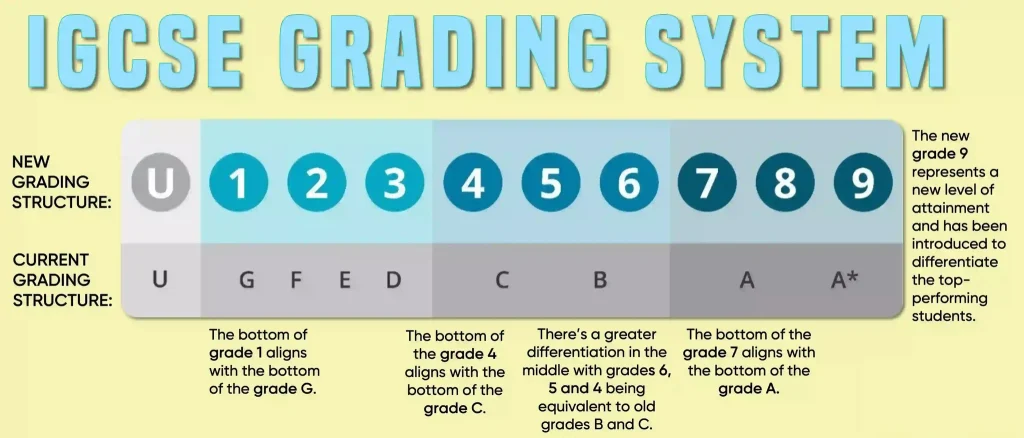
IGCSE exams use grading scales such as A*–G or 9–1
- The difficulty of the exam paper.
- The overall performance of candidates globally.
Therefore, understanding the mark scheme and scoring criteria is crucial in your exam preparation strategy.
The Role of Past Papers in IGCSE Exam Preparation
Past papers are essential tools for students to become familiar with several key aspects of the examination:
- Question structuring:
- Mark allocation:
- Answer presentation requirements
However, their true value lies in analyzing the mark scheme and examiner report, rather than just the number of papers completed.
Previous Cambridge IGCSE exam papers (Basic and Advanced programs) – 3-year set of papers (2022, 2023, 2024)
Timing Your Preparation
Preparing for the IGCSE exam requires a long-term commitment. To understand the registration process, you should consult the specific website of each exam board or the British Council’s official page.
A common and effective preparation roadmap typically spans 12–18 months and includes the following stages:
- Phase 1: Consolidating foundations.
- Phase 2: Practicing by topic/question type.
- Phase 3: Completing full papers under timed conditions.
This structured approach helps students gradually adapt to international academic assessment standards.
Conclusion
The IGCSE exam is not regarded as “difficult” in the sense of being complex or misleading; rather, it is an evaluation that necessitates careful planning and a thorough comprehension of its fundamental principles.
Students’ revision becomes more efficient and strategically focused once they have a comprehensive understanding of the exam’s question-setting techniques, marking schemes, and academic criteria. In this regard, the IGCSE exam plays a crucial role in preparing students for their future educational courses by assisting them in becoming acquainted with worldwide academic assessment standards.