


In modern society, critical thinking is an essential skill, extending far beyond academic success. Schools worldwide are emphasising critical thinking and integrating it into their curricula to equip students with the ability to navigate complex information, solve problems creatively, and foster lifelong learning.
What is critical thinking?
Critical thinking is the ability to analyse information and make reasonable judgements based on multidimensional research, processing and evaluating information based on reasoning, “thinking about thinking in an intellectually disciplined manner,” multidimensional thinking and critical reflection on issues, and synthesising cognitive abilities, attitudes, and behaviours to creatively solve learning tasks.
This complex skill is comprised of several key components:
- Open-mindedness: A willingness to consider different perspectives and ideas, even those contrary to one’s own.
- Analysis: The ability to break down complex information into smaller parts to understand their relationships.
- Interpretation: Understanding the meaning and significance of data and arguments.
- Problem-solving: Applying logical steps to find effective solutions to challenges.
- Decision-making: Forming sound judgements and choosing the best course of action based on evidence.
- Effective Communication: Clearly articulating thoughts and arguments, both verbally and in writing.
- Self-improvement: Continually assessing one’s own thinking process and seeking ways to enhance it.
- Asking Questions: Probing deeper into topics, seeking clarification, and challenging assumptions.
- Identifying Controversial Issues: recognising areas of debate and differing viewpoints.
- General about critical thinking

General about critical thinking
- Defending One’s Stance: Articulating and supporting one’s arguments with evidence and reasoning.
- Listening to Opinions: Actively engaging with and understanding the views of others.
- Criticising Wrong Things: Identifying flaws or fallacies in arguments or information.
- Detecting Contradictions in Arguments: Spotting inconsistencies within a line of reasoning.
- Analysing to Clarify Issues: Delving into details to gain a clearer understanding of a problem
Importance of Critical Thinking in Learning and Life
Critical thinking stands as an indispensable life skill, impacting every domain from academic pursuits to personal relationships and professional success. In an age saturated with information, the ability to analyse data effectively, improve problem-solving capabilities, and make sounder decisions is paramount.
Beyond intellectual benefits, critical thinking significantly improves relationships by fostering a deeper understanding of others’ perspectives, encouraging empathy and constructive dialogue. It strongly activates creativity and curiosity, prompting individuals to question the status quo and explore novel solutions. For students, critical thinking offers significant benefits, allowing them to form deeper arguments, thoroughly understand complex issues, and actively seek solutions instead of just memorising facts.

The importance of critical thinking skills
Critical Thinking vs. Memorisation
The traditional emphasis on rote memorisation often stands in stark contrast to the development of critical thinking. While memory involves recalling facts and information, critical thinking goes beyond this by encouraging students to understand why those facts are true, how they relate to other concepts, and how they can be applied in different contexts.
Critical thinking champions an active, inquiry-based approach to learning, where students are encouraged to question, analyse, synthesise, and evaluate information. In contrast, an overreliance on memorising can lead to passive learning, where students merely absorb information without truly comprehending or being able to apply it.
Comparison between critical thinking and memorisation
How to Develop Critical Thinking at Specific Educational Levels
Developing critical thinking is a continuous process that should be nurtured from the earliest stages of education, progressively building complexity as students advance through their academic journey.
At Preschool and Primary School Levels
At the preschool and primary school levels, the focus is on planting foundational elements of critical thinking. This includes actively encouraging curiosity and fostering a habit of asking simple yet profound questions like “Why?” and “How?”
Throughout this stage, emphasising the role of teachers and parents in creating a safe and supportive environment is paramount, ensuring children feel comfortable expressing their opinions, asking questions without fear of judgement, and exploring their world with an inquisitive mind.
At the High School Level
The majority of students recognise manifestations of critical thinking (asking questions, criticising the wrong things, and defending one’s position). There are differences in how 10th and 12th graders perceive aspects of critical thinking, with 10th graders focussing on questioning and 12th graders emphasising criticism and defence.
Measures and Strategies to Develop Critical Thinking in Schools
For critical thinking to truly flourish, it needs to be systematically cultivated through deliberate and consistent pedagogical approaches within the school environment. This requires a paradigm shift in teaching philosophy and practical implementation.
Innovating Teaching Methods
Schools must move away from passive transmission of knowledge towards approaches where students actively construct knowledge. This involves:
- Implementing interactive learning: Regularly applying discussions, debates, case studies, collaborative group work, and engaging presentations encourages students to think critically, share ideas, and challenge perspectives.
- Employing questioning techniques: Teachers should utilise advanced questioning techniques that promote deeper thinking and move beyond recall.
- Using technology and online learning environments: These platforms can foster richer discussions and provide students with ample time to reflect on complex issues.
- Using assignments requiring introspection and analysis: Shifting from tasks based on mere recall or description to assignments that demand critical evaluation, synthesis of information, and the formation of reasoned judgements.
- Integrating CT into specific subjects: Critical thinking should not be taught in isolation but woven into the fabric of every discipline.

CT teaching methods
Building a Critical Thinking Culture
Beyond specific methods, schools must intentionally build a culture of critical thinking. This means creating a safe and inclusive environment where students feel genuinely comfortable expressing their opinions, engaging in healthy debate, and asking challenging questions without fear of being wrong or judged. This open atmosphere encourages intellectual risk-taking and fosters a community of curious, analytical learners.
Key Critical Thinking Skills Students Should Develop
Developing critical thinking involves mastering a set of core intellectual abilities and cultivating certain mindsets that support deep, reflective thought.
Core Skills
- Analytical Thinking: The ability to scrutinise information, break it down into components, and understand how those parts relate to the whole.
- Open-mindedness: A crucial trait that involves being receptive to new ideas, different perspectives, and alternative solutions, even if they challenge existing beliefs.
- Reasoned Judgement: The capacity to form sound conclusions and make sensible decisions based on logical reasoning and comprehensive evaluation of evidence.
- Reflective Thinking: The practice of stepping back to consider one’s own thought processes, assumptions, and biases, leading to self-correction and continuous improvement.
- Communication: Clearly articulating complex ideas, questions, and conclusions, both orally and in writing, to effectively share insights and engage in constructive dialogue.
- Research: The skill of effectively gathering, evaluating the credibility of, and synthesising information from various sources to build a comprehensive understanding.
- Decision-making: The process of weighing options, considering potential outcomes, and selecting the most appropriate course of action based on critical analysis.
- Problem-solving: Systematically identifying challenges, exploring root causes, brainstorming potential solutions, and evaluating their effectiveness.
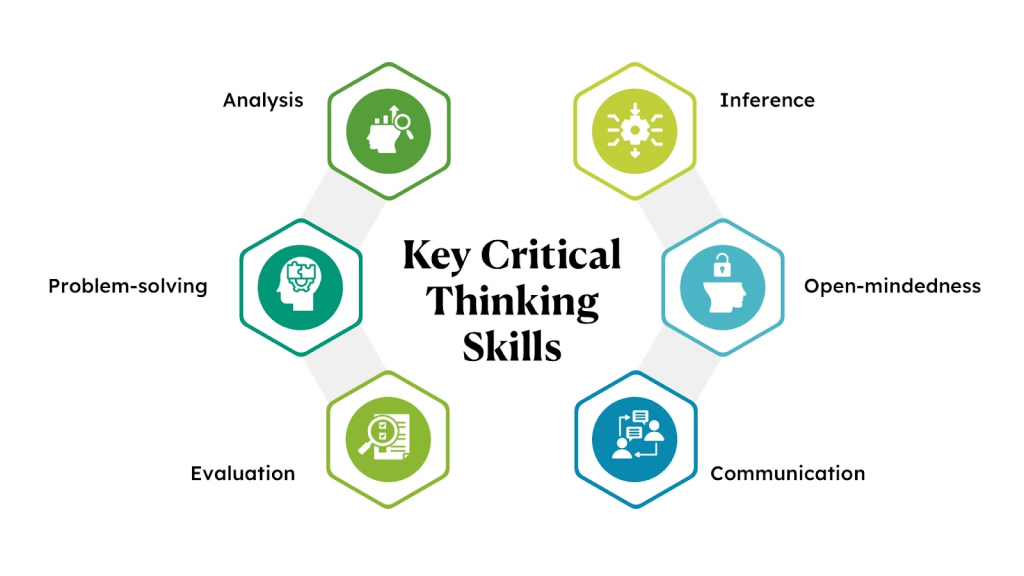
Core skills for students
Mindsets to Cultivate
- Willingness to listen to other perspectives: An active desire to understand and consider viewpoints that differ from one’s own, fostering empathy and broader understanding.
- Courage to ask questions and defend one’s stance: The bravery to challenge assumptions, probe deeper, and articulate and support one’s own reasoned conclusions, even in the face of opposition.
- Flexible thinking, adapting to multifaceted perspectives: The cognitive agility involves shifting viewpoints, considering issues from various angles, and integrating new information into a more comprehensive understanding.
Challenges in Developing Critical Thinking in Vietnam
Despite the recognised importance of critical thinking, its comprehensive development in educational systems, particularly in Vietnam, faces several significant challenges.
From Students’ Side:
Students may exhibit passivity in learning, often due to overwhelming exam pressure that prioritises rote memorisation over deep understanding. This focus on test scores can lead to a lack of genuine interest in inquiry-based learning.
From Teachers’/Schools’ Side:
Teachers and schools often face challenges stemming from a lack of knowledge or experience in applying specific methodologies for teaching critical thinking. More systematically, there’s a lack of clear measurement and coherent strategies for assessing critical thinking, as current assessment systems often heavily focus on memorising facts.
Challenges of CT development in Vietnam
Frequently Asked Questions (FAQs)
Understanding critical thinking can sometimes lead to common misconceptions or questions. Here are some frequently asked questions that shed light on various aspects of critical thinking.
Is critical thinking too difficult for young students?
No, critical thinking is not too difficult for young students. Its development can begin with simple yet powerful questions like “Why?” or “What if…?” These types of questions encourage curiosity, observation, and basic problem-solving from an early age, laying the groundwork for more complex critical thinking skills later on.
Does critical thinking mean arguing?
No, critical thinking is not synonymous with arguing. While it involves evaluating arguments and sometimes challenging ideas, it is about analysing and responding in a constructive, reasoned manner based on evidence and logic. It encourages respectful dialogue rather than aggressive opposition.
Is it possible to teach critical thinking, or does it come naturally?
Critical thinking is not an innate ability. While some individuals may have a natural inclination for inquiry, critical thinking is a complex set of skills and dispositions that must be systematically taught, practiced, and cultivated over time through deliberate educational strategies and consistent application.
FAQs about critical thinking
How to develop critical thinking skills in 7
A structured process can systematically approach the development of critical thinking skills. This seven-step method provides a clear framework for analysing problems, evaluating information, and drawing well-reasoned conclusions.
Let’s start with the basics: When should I use the 7-step critical thinking process?
This process is most effective when facing complex problems, making important decisions, evaluating new information, or developing solutions that require analysis rather than simple recall.
1. Identify the problem or question
Clearly define the issue at hand. What precisely requires comprehension or resolution? A precise definition ensures that subsequent steps are focused and relevant.
2. Gather relevant information
Collect all necessary data, facts, and evidence related to the identified problem. This involves distinguishing between reliable and unreliable sources, ensuring the information gathered is accurate, comprehensive, and unbiased.
3. Analyse and evaluate the data
Critically examine the collected information. Search for patterns, connections, contradictions, and potential biases. Evaluate the credibility of sources and the validity of arguments. This step involves questioning assumptions and identifying underlying issues.
4. Consider alternative points of view
Actively seek and understand different perspectives on the issue. This involves empathy and intellectual humility, recognising that there might be multiple valid ways of looking at a problem. This broadens understanding and prevents narrow-mindedness.
5. Draw logical conclusions
Based on the analysis and evaluation of all information and perspectives, formulate logical conclusions. These conclusions should be supported by evidence and reasoning, avoiding hasty generalisations or emotional responses.
6. Develop and communicate solutions
If the process is problem-orientated, generate creative and viable solutions based on your logical conclusions. Then, articulate these solutions clearly and persuasively, considering your audience. This step often involves using decision-making tools for agile businesses, allowing for rapid evaluation and implementation of effective strategies.
7. Reflect and learn from the process
Finally, review the entire critical thinking process. What worked well? What could be improved? Reflect on the outcomes of your decisions or solutions, and use these insights to refine your critical thinking skills for future challenges. This continuous learning cycle is key to personal and professional growth.